
Tellent Review: Smarter HR Decisions Through ATS, HRIS, and Performance Tools
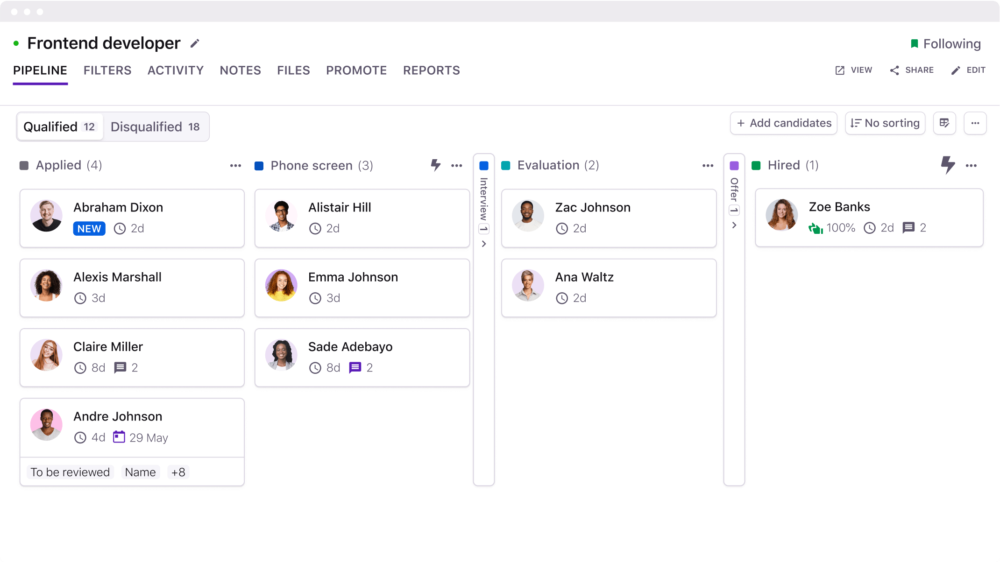
HR software only “works” when it reduces friction in real workflows: hiring managers moving too slowly, candidates ghosting mid application, payroll data living in spreadsheets, performance reviews that arrive late and add little value, and an HR tech stack that grows into a patchwork of logins and integrations.
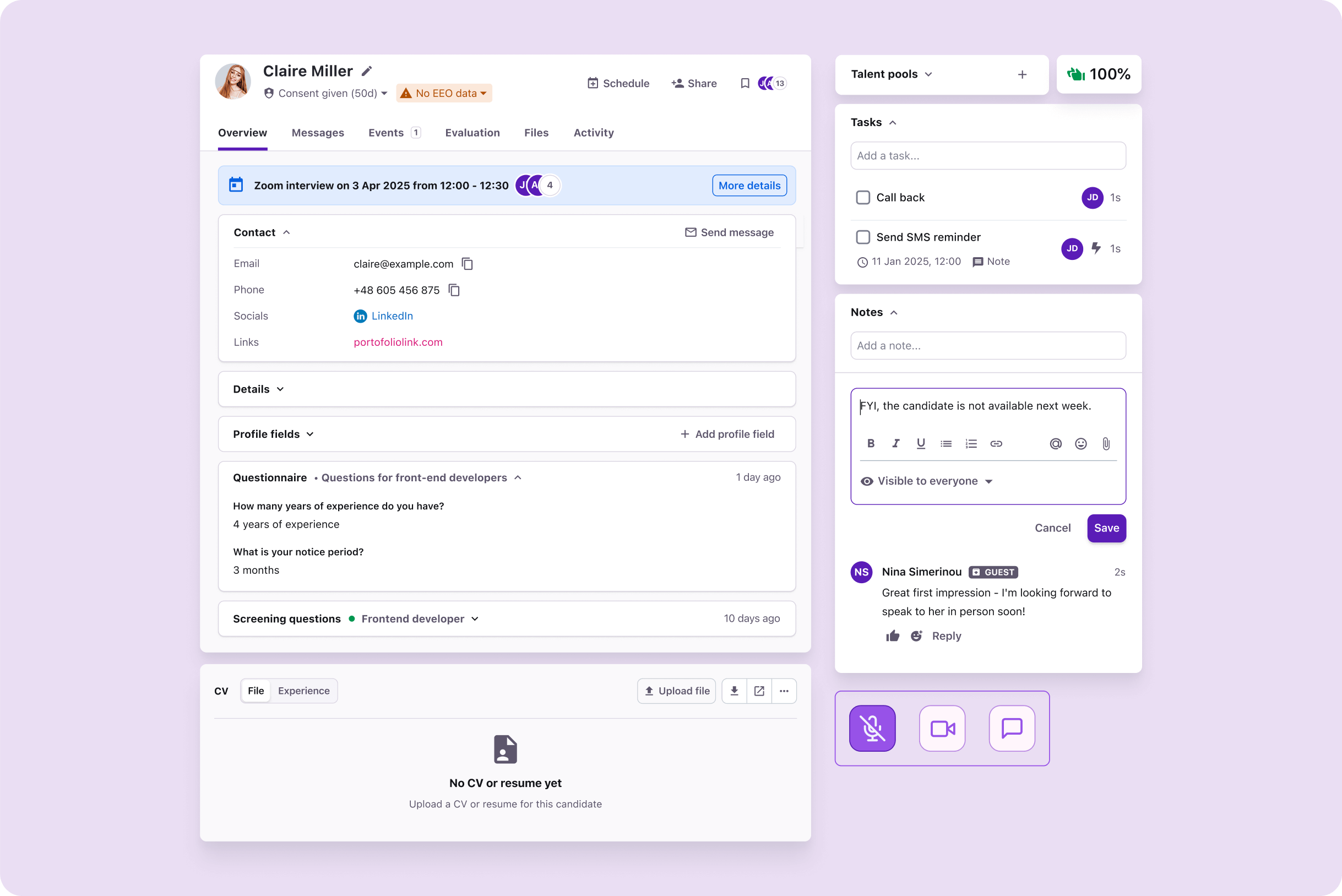
Tellent positions itself as the antidote to that patchwork: a People Decision Platform that brings together applicant tracking (Tellent Recruitee), core HR (Tellent HR Manage), performance and engagement (Tellent HR Grow), and a layer of AI and automation (Tellent Intelligence). The promise is simple: less admin work, more consistency, and better decisions across the employee lifecycle.
TellentOverall verdict (short version): 8.6/10
Best for: teams that want a modular, Europe-first HR platform that can cover both hiring and core HR without an enterprise-scale implementation—especially if ATS collaboration, automation, and integrations matter.
Not ideal for: organizations that need complex global payroll across many countries, deeply customized enterprise workflows, or extremely advanced people analytics as the primary buying driver.
Here’s what this review covers
- Introduction
- Overview and company background
- Pricing and plans (with tables and hidden cost considerations)
- Setup and onboarding experience
- User experience and ease of use
- Core feature breakdown (ATS, HRIS, performance, engagement, automation)
- AI features and roadmap direction
- Integrations (with practical top integrations table)
- Performance, reliability, and security
- Customer support and resources
- Pros and cons
- User reviews and ratings summary
- Alternatives and comparisons
- Who Tellent is best for (and who should avoid it)
- Final verdict and recommendations
- FAQ (15 questions)
Introduction
The pain point: HR “tools” fail when they don’t fit real workflows
In most organizations, HR friction isn’t theoretical—it’s operational:
- Hiring managers move slowly and feedback arrives late.
- Candidates drop mid-process because communication and scheduling break down.
- Payroll inputs live in spreadsheets and handoffs are error-prone.
- Performance reviews happen late and add limited value.
- HR tech stacks become a patchwork of logins, tools, and inconsistent data.
Tellent’s product thesis is that you fix this by consolidating the workflow surfaces that matter—recruiting, HR operations, performance/engagement—and then layering in automation and AI to reduce admin work and improve consistency.
Practical takeaway: Tellent is most compelling when you want a suite-like ecosystem (ATS + HRIS + performance) without committing to an enterprise HCM rollout.
Overview and company background
What is Tellent?
Tellent is a modular HR platform built around two core product pillars:
- Tellent Recruitee: an applicant tracking system designed for collaborative hiring and automation.
- Tellent HR: a core HRIS with built-in performance management, sold as Manage (HRIS) and Grow (performance, engagement, development).
On top of that, Tellent is layering Tellent Intelligence, focused on AI-assisted writing, summarization, translation, candidate insights, fairness controls, and an emerging conversational interface for employee self service.
How Tellent was formed (and why it matters)
Tellent is a platform that emerged from the combination of multiple HR software products. In 2022, Recruitee (ATS) and Javelo (performance management) announced the acquisition of KiwiHR (HR management system for SMBs) and joined forces under a new group leadership called Tellent.
Tellent also expanded capabilities through acquisition in 2025 with FunnelBridge, adding WhatsApp-based hiring workflows for deskless and high-volume hiring use cases.
Why this matters for buyers:
- You are adopting a platform that is actively converging multiple products into a more unified experience.
- Some parts of the suite are still in transition (for example, references to migrating Javelo into Tellent HR in 2026 signal ongoing consolidation).
- The upside is maturity: each module comes from a product with its own market fit before becoming part of a broader suite.
Market positioning and target audience
Tellent is best understood as a mid-market and scaling-company platform. The strongest fit tends to be:
- People teams that need a serious ATS plus solid HRIS and performance tooling, without a heavyweight enterprise HR implementation.
- Organizations hiring across multiple teams that want structured collaboration and automation in recruiting.
- European companies (or global companies hiring heavily in Europe) that prioritize compliance posture and clear data governance.
Pricing and plans
Tellent pricing is modular. You typically buy:
- Tellent Recruitee (ATS) in one of three tiers
- Tellent HR in one of two modules (Manage and Grow are priced separately, and you can run them together)
- Optional add-ons (SSO, texting, Journeys, WhatsApp Hiring, AgencyHub, payroll integrations)
Budgeting note: Tellent pricing typically increases by company size, and annual billing is positioned as offering ~20% savings. Confirm your pricing band during sales conversations.
Tellent Recruitee pricing (ATS)
Below is pricing as presented in the provided brief (starting prices; expected to rise with company size):
| Plan | Starting price (monthly) | Annual billing equivalent (est., ~20% savings) | Job posts | Best for | Key inclusions |
|---|---|---|---|---|---|
| Start | €301 / month | ~€241 / month | 5 active job posts | Early-stage teams formalizing hiring | CareersHub single-page no-code site, multi-job board posting, collaboration tools, pipeline automation, AI email/feedback writing, email & calendar sync, standard reporting, mobile app |
| Advance | €384 / month | ~€307 / month | 10 active job posts | Growing teams hiring across departments | Multi-page CareersHub (custom fonts/colors/domains), branded emails, video interviews, job board syndication, API + webhooks, advanced reporting/analytics, AI job translations, Google & Microsoft SSO |
| Optimize | €1,416 / month | ~€1,133 / month | 25 active job posts | High-volume hiring or mature TA operations | Custom contracts, enterprise onboarding support, agency management, advanced permissions & audit logs, BI connector, AI fairness tools, priority support, dedicated CSM |
Tellent HR pricing (HRIS and Performance)
Tellent HR is sold in two modules:
- Manage: core HRIS
- Grow: performance management and engagement
| Module | Starting price (monthly) | Annual billing equivalent (est., ~20% savings) | Best for | Core focus |
|---|---|---|---|---|
| Manage | €83 / month | ~€66 / month | Centralizing HR operations | HRIS, time & attendance, absence, expenses, payroll readiness, HR reporting, Journeys, whistleblowing, integrations |
| Grow | €83 / month | ~€66 / month | Improving performance and engagement | Performance reviews, 360 feedback, engagement surveys, development plans, objectives and analytics (with AI-assisted elements) |
Add-ons and hidden costs to plan for
Tellent is modular by design. Common cost drivers include:
- SSO add-on (if needed outside included plan features)
- Texting add-on (candidate messaging)
- Journeys add-on
- AgencyHub add-on
- WhatsApp Hiring add-on
- Payroll integrations (HR Manage)
- Implementation/services (Optimize includes enterprise onboarding support; complex rollouts may require structured onboarding)
Value for money: who each level suits best
- Start: minimum viable setup for standardizing hiring (careers page + job distribution + collaboration + automation basics).
- Advance: best “platform leverage” tier (API/webhooks, better reporting, deeper CareersHub controls).
- Optimize: governance and scale (audit logs, permissions, BI connector, enterprise support).
- Manage: centralizes HR operations (time off, attendance, payroll readiness, employee records).
- Grow: adds performance and engagement cadence (reviews, objectives, feedback loops, survey insights).
Bottom line: Tellent pricing is easiest to justify when you treat it as a workflow consolidation move (ATS + HRIS + performance), not as “one more HR tool.”
Setup and onboarding experience
Tellent promotes fast starts, including trial access for Recruitee (commonly positioned as no credit card required). That said, “easy to start” and “easy to scale correctly” are different.
A realistic onboarding path for Tellent Recruitee (ATS)
Week 1 goal: run one hiring process end-to-end in Recruitee.
- Create roles and permissions: set up access so recruiters, hiring managers, and interviewers can collaborate cleanly.
- Build one structured pipeline: start by copying your current stages, then simplify.
- Launch CareersHub + publish one job: validate the end-to-end candidate experience.
- Connect email and calendar: reduce scheduling friction immediately.
- Pick one automation that saves time: focus on eliminating repetitive work (auto-assignment, templates, reminders).
- Add one integration that reduces context switching: typically Slack/Teams, e-signature, or scheduling.
A realistic onboarding path for Tellent HR (Manage and Grow)
Phase 1: HR foundations (Manage)
- Employee database and org chart
- Time and attendance tracking and absence policies
- Payroll readiness workflow (data accuracy, pay run review, pay sheets)
Phase 2: Performance layer (Grow)
- Define review templates and cycles
- Establish objectives and progress tracking
- Add engagement surveys once you have a rhythm for acting on results
Implementation reality: The tool rarely fails because of UI. It fails when policies, ownership, and workflows are not agreed and enforced.
User experience and ease of use
You can usually tell who a platform is built for by where it tries to remove friction:
- Recruitee reduces friction between recruiters and hiring teams (pipelines, collaboration, automation).
- Tellent HR reduces friction between HR operations and employee self service (time off, attendance, journeys, reviews, surveys).
Recruitee UX: hiring-first workflows
- Pipeline-centric navigation
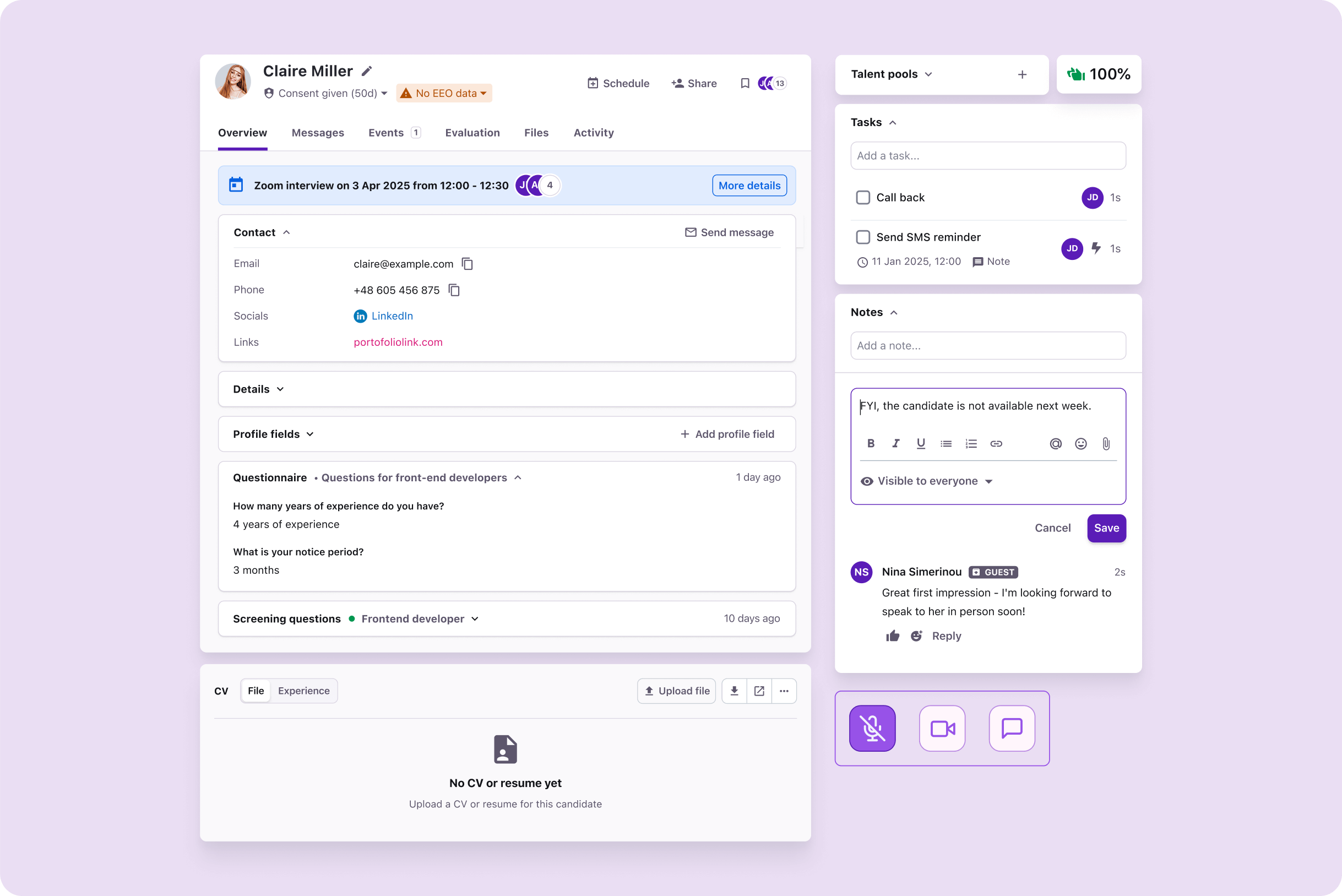
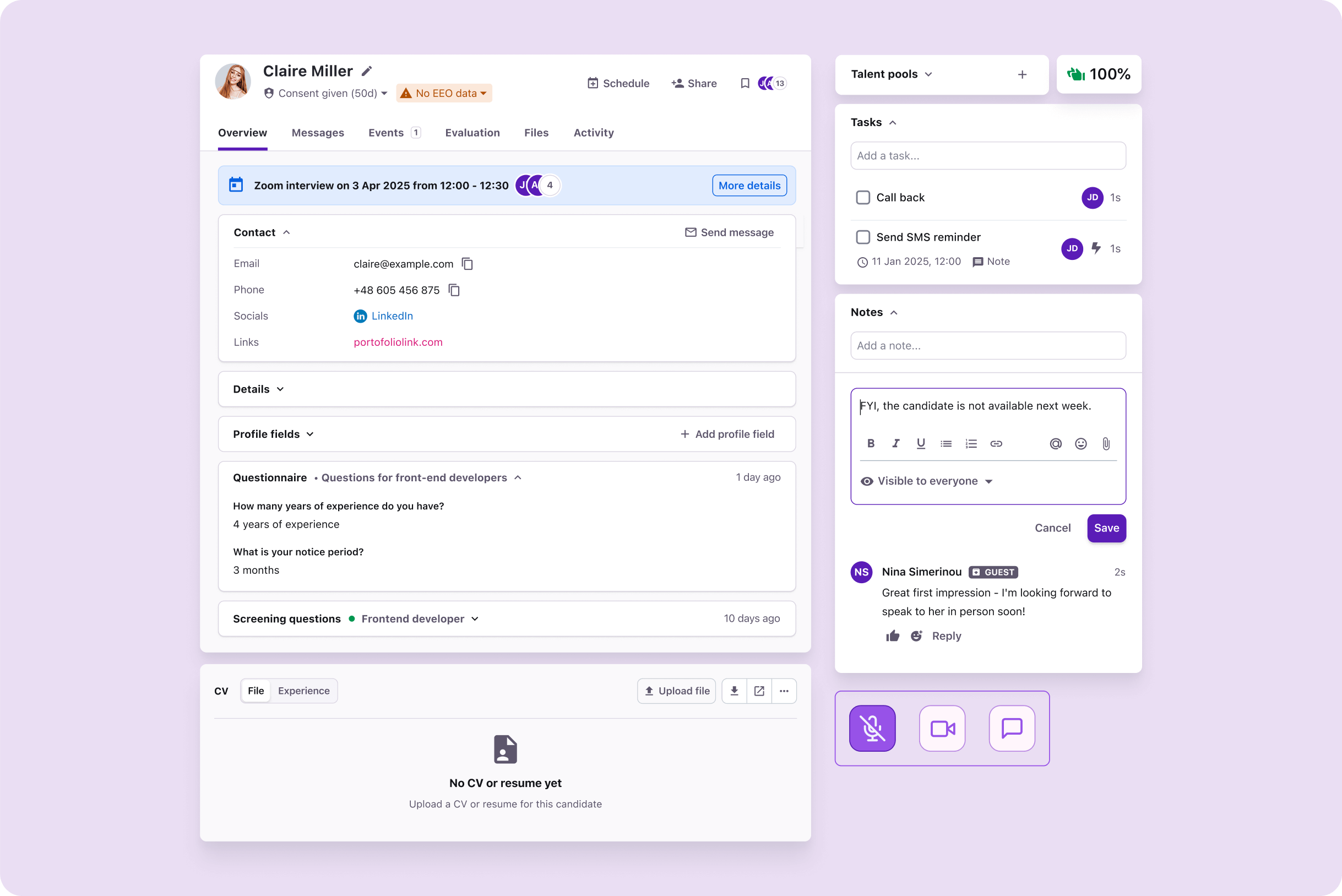
- Candidate profiles as the hub for communication and evaluation
- Automation triggers that act on stage movements and events
- Collaboration surfaces for feedback and decisions
Mobile experience
Two mobile use cases matter in HR software:
- Managers reviewing candidates and providing feedback quickly
- Employees interacting with HR tasks (time off requests, time tracking, surveys)
Learning curve: feature discovery vs process design
Feature discovery is usually straightforward (especially for recruiters using an ATS). Process design is where complexity appears at scale: roles, permissions, pipelines, reporting structures, and governance.
Core feature breakdown
Because Tellent is modular, the clearest way to evaluate it is by product pillar. If you buy the full platform, your experience will be the combination of these modules.
1) Tellent Recruitee (ATS)
A. Employer branding and CareersHub
Start includes a no-code CareersHub site. Advance adds multi-page customization and branding controls (custom fonts, colors, domains). Localization support is positioned as a strength for multi-region hiring teams.
B. Applicant management and pipeline automation
Recruitee is designed around pipeline stages and workflow automation. A good ATS keeps the process consistent (so nothing falls through cracks) while staying flexible (so different roles can follow different paths).
Practical example (high-volume role)
- Pipeline: Application → Screen → Assessment → Hiring manager interview → Final → Offer → Hired
- Automation: auto-assign recruiter, trigger scorecards, send templates, create “stuck in stage” reminders
C. Collaboration and hiring team alignment
Recruitee’s differentiation is collaboration-first hiring: structured feedback, shared visibility, and multi-channel candidate communication (email/SMS/WhatsApp, depending on configuration).
D. Interviewing and evaluation
Advance includes video interviews, and marketplace integrations commonly cover Teams/Zoom/Google Meet. A strong operating model keeps the ATS as the system of record and the meeting tool as the execution layer.
E. Automation and AI writing support
AI features in Recruitee are positioned to start with productivity accelerators (email and feedback drafting, translation) and scale up to governance-heavy tooling (fairness controls) at higher tiers.
F. Compliance and governance
Governance features (2FA/SSO, granular permissions, auditability) become increasingly important as recruiting teams scale and data access requirements tighten.
2) Tellent HR Manage (HRIS)
A. Employee database and org structure
Manage positions itself as an HR system of record: employee database, org chart, and HR reporting.
B. Time, attendance, and absence management
Time tracking is a common HRIS failure point because policy variance is real (contracts, overtime, shift work, and country-specific regulations). Manage emphasizes time tracking and a clock-in station for deskless workflows.
C. Payroll readiness (not payroll replacement)
Manage is framed around payroll readiness: consolidating payroll inputs so payroll runs and payslips are less error-prone. In many environments, the best architecture is HRIS + payroll provider + integrations.
D. Journeys (employee lifecycle workflows)
Journeys function as reusable templates for onboarding/offboarding and internal employee lifecycle events. This is where HR systems begin to behave like operational runbooks.
E. HR reporting
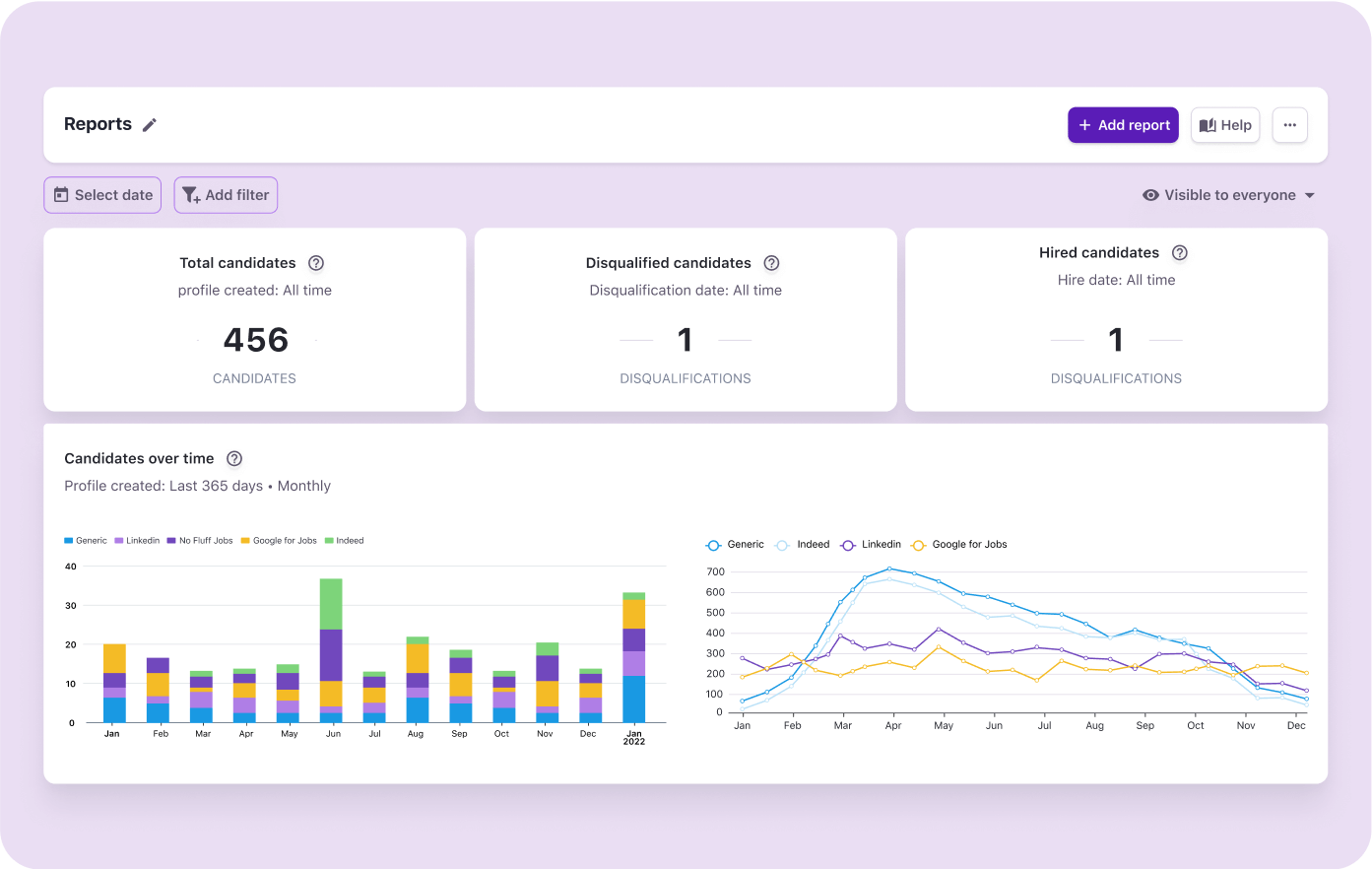
Reporting becomes valuable when it is decision-oriented (headcount/turnover/tenure segmentation aligned to how leadership runs the business), not only compliance-oriented.
3) Tellent HR Grow (Performance, Engagement, Development)
A. Performance reviews and check-ins
Grow positions performance management as a cadence: review templates, automated cycles and reminders, secure storage of notes, and dashboards for HR visibility.
B. Objectives and alignment
Objectives are useful only if they are simple enough to maintain and leadership references them. Grow appears positioned to connect objectives to reviews and feedback loops (instead of treating OKRs as a separate universe).
C. 360 feedback
360 feedback works best when piloted with a short template and a narrow group first. The value comes from consistency and follow-through, not form length.
D. Engagement surveys and sentiment analysis
Grow emphasizes recurring surveys, anonymization, dashboards, filtering, sentiment analysis, and auto-generated charts to reduce analysis time. The operational win comes from the action loop (collect → interpret → change → communicate → repeat).
E. Development planning
Development becomes strategically useful when it connects review outcomes to skills mapping and training plans—so learning is tied to business needs and employee growth.
AI features and roadmap direction
Tellent Intelligence (AI): what it does well—and where to be cautious
Tellent Intelligence is framed as purpose-built AI and automation to save time and improve decision-making. Common use cases include:
- Writing job descriptions faster
- Translating job postings
- Generating professional rejection emails
- Summarizing evaluation feedback
- Candidate insights and risk flagging
- Bias reduction (e.g., removing sensitive resume details)
- Survey summarization and sentiment analysis
- Workflow automations (triggers, conditions, actions)
- A coming conversational assistant (“Ask HR”) for employee self service
A practical AI evaluation framework
- Category 1: Productivity accelerators (drafting, translation, summarization) — usually safest and valuable quickly.
- Category 2: Decision support (matching, red flags, sentiment insights) — valuable but requires governance and auditability.
- Category 3: Process automation — high ROI when configured well; riskier if triggers are misconfigured.
Roadmap direction: screening assistant and HR assistant
The product direction described in the brief emphasizes an AI screening assistant for recruiters and an HR assistant concept for employee questions and HR ticketing-style workflows. If these land well, they strengthen the suite story; if partial, you may still rely on external chatbots and knowledge base workflows.
TellentIntegrations
Integration ecosystem
Tellent’s marketplace is positioned as a major strength, providing faster time to value and less custom integration work. Native integrations typically deliver faster setup, better reliability, and clearer support pathways when something breaks.
Top integrations table (practical picks)
| Integration | Category | Why it matters | Notes |
|---|---|---|---|
| Slack | Collaboration | Faster stakeholder response by routing candidate updates into channels | Common “speed” lever for hiring teams |
| Microsoft Teams | Video interviews | Schedule/hold interviews without leaving the ATS workflow | Reduces context switching |
| Zoom | Video interviews | Common distributed interview platform | Useful for global teams |
| Google Meet | Video interviews | Lightweight interviews for Google Workspace environments | Fast setup |
| Zapier | Automation | Connect workflows across many apps quickly | Best for no/low-code ops |
| Make | Automation | Flexible workflow automation alternative to Zapier | Common for technical teams |
| LinkedIn Recruiter System Connect | Sourcing | Reduce copy/paste by moving candidate data into ATS faster | High impact for recruiter throughput |
| Apply with LinkedIn | Candidate experience | Reduce application friction | Helpful for top-of-funnel conversion |
| Indeed Apply | Candidate experience | Improve completion rate for job board applicants | Common for high-volume hiring |
| DocuSign | E-signature | Offer letters/contracts signature workflows | Reduces offer-stage friction |
| WhatsApp Hiring | Messaging | Higher conversion and faster engagement for deskless hiring | Most relevant in frontline-heavy industries |
| Tellent HR integration | HRIS sync | Send hired candidates from ATS into HRIS with tracked field mapping | Key for suite consolidation benefits |
| ADP Workforce Now | Payroll/HR suite | Common enterprise payroll connection path | Confirm scope during integration review |
| Personio | HRIS | EU HRIS commonly paired with ATS for handoffs | Relevant for Europe-heavy orgs |
| HiBob | HR platform | Mid-market HR platform commonly paired with ATS | Often used in scaling companies |
For broader automation, system integrators (Zapier/Make) provide “glue” across tools when native integrations are not available.
Performance, reliability, and security
Uptime and reliability signals
Tellent operates a public status page for Recruitee, Tellent HR, APIs, and supporting components. Transparent uptime reporting is a positive maturity signal (though not a substitute for contractual SLAs if needed).
Scalability
Tellent is positioned for mid-market scale. The more important scaling question is whether product depth matches your HR complexity (countries/legal entities, payroll architecture, permissions, analytics needs, and high-volume recruiting operations).
Security and compliance posture
Security posture is positioned as a strength in Recruitee (governance controls such as 2FA/SSO, permissions, audit logs, and compliance signals like GDPR/ISO/SOC). For regulated environments, validate through your formal security review (DPA, subprocessors, data residency, audit logs, SSO/SAML, etc.).
Customer support and resources
Support quality is best validated via a pilot (response time, configuration support, and escalation handling). In the provided brief, Tellent is described as offering multiple help centers and higher-tier support options (priority support and dedicated CSM on higher ATS tiers), as well as local support emphasis in some European regions.
Practical advice: If you are adopting multiple modules (ATS + HR + performance), ask how support is structured across modules to avoid handoff friction.
Pros and cons
| Pros | Cons |
|---|---|
|
|
User reviews and ratings summary
User sentiment is most reliable when sample sizes are meaningful and themes are consistent. The provided brief cites the following directional ratings:
| Product | Review site | Rating (as cited) | Notes |
|---|---|---|---|
| Tellent Recruitee | G2 | 4.5 / 5 (449 reviews) | Meaningful sample size for ATS evaluation |
| Tellent Recruitee | Capterra | 4.4 / 5 (194 reviews) | Often praised for flexibility; complexity can appear at scale |
| Tellent Recruitee | TrustRadius | 8.3 / 10 | Directional; validate with your pilot |
| Tellent HR | G2 | 4.3 / 5 (2 reviews) | Small sample size; supplement with references and pilot |
What to do with this: Treat ATS ratings as more statistically meaningful. Treat HRIS/performance ratings as directional and validate via structured pilot and customer references.
Alternatives and comparisons
ATS alternatives to Tellent Recruitee
- Greenhouse
- Lever
- Workable
- Teamtailor
- Ashby
HRIS and performance alternatives to Tellent HR
- BambooHR
- Personio
- HiBob
- Factorial
- Leapsome (strong for performance & engagement)
When Tellent is the better choice
- You want ATS + HRIS + performance in one ecosystem without enterprise implementation overhead.
- Collaboration and automation in recruiting are priorities.
- You want strong integration breadth and modern messaging-based hiring options (e.g., WhatsApp workflows) for deskless recruiting.
When an alternative may be better
- You need enterprise-grade global payroll and benefits administration across many countries.
- You require deeply customized HR workflows and advanced people analytics as the primary requirement.
- You want a fully unified “single-suite” experience immediately and do not want to adopt during a convergence phase.
Who Tellent is best for (and who should avoid it)
Best for
- Scaling companies that want one ecosystem for hiring and HR operations: replacing an ATS + HR spreadsheets + separate performance tool with a more unified platform.
- Teams with deskless or high-volume hiring needs: especially where WhatsApp workflows improve engagement and conversion.
- HR teams that want time tracking and payroll readiness without a full HCM: HRIS + integrations architecture.
- Organizations that want governance without enterprise overhead: permissions, SSO/2FA, auditability, and compliance posture.
Not ideal for
- Very large enterprises with complex HR and payroll requirements: multi-country payroll complexity and deep customization needs may exceed suite depth.
- Buyers who want a single fully unified suite today: consolidation signals suggest a convergence journey is ongoing.
- Organizations that want everything included in one price: modular add-ons can accumulate quickly.
Final verdict and recommendations
Rating: 8.6/10
Rating breakdown (publication-friendly):
- ATS features and hiring workflows: 9.0/10
- HRIS and HR operations: 8.3/10
- Performance and engagement: 8.4/10
- Integrations and ecosystem: 9.2/10
- Security and governance: 9.0/10
- Pricing clarity and packaging: 7.9/10
- Reliability signals: 8.8/10
My recommendation
Choose Tellent if you want a modular, mid-market platform that can credibly support:
- Structured, collaborative recruiting (Recruitee)
- Central HR operations with time/attendance and payroll readiness (HR Manage)
- Performance and engagement systems that run on a cadence (HR Grow)
- Practical AI assistance for writing, translation, summarization, and emerging governance features (Tellent Intelligence)
Recommended evaluation plan (structured pilot)
If you’re unsure, the most reliable evaluation method is a structured pilot:
- Run one role through the ATS end-to-end.
- Run one month of HR operations through Manage (time off, attendance, payroll readiness).
- Run one lightweight survey or review cycle through Grow.
- Validate your top 5 integrations early (Slack/Teams, e-signature, HRIS sync, and one automation tool like Zapier).
Call to action: If your biggest pain is fragmentation (ATS + HR spreadsheets + scattered performance tools), Tellent is worth a serious evaluation—especially if you value a Europe-first posture and strong ATS collaboration.
FAQ (15 questions)
1) What is Tellent, in plain terms?
Tellent is a modular HR platform made up of an ATS (Tellent Recruitee), an HRIS (Tellent HR Manage), performance and engagement tools (Tellent HR Grow), and an AI layer (Tellent Intelligence).
2) Is Tellent the same as Recruitee?
No. Recruitee is one major part of Tellent (the ATS module). Tellent HR and Tellent Intelligence cover HR operations and performance processes.
3) Does Tellent offer a free plan?
The brief references free trial availability (especially for Recruitee), but not a free tier. Confirm trial scope during signup.
4) How much does Tellent cost?
As cited in the brief: Recruitee starts at €301/month (Start), €384/month (Advance), and €1,416/month (Optimize). Tellent HR Manage and Grow are each cited as starting at €83/month. Pricing typically increases by company size; annual billing is positioned as discounted.
5) Is Tellent priced per user?
The brief describes starting monthly prices that increase by company size, rather than a simple per-user model. Confirm your employee band and pricing mechanics during procurement.
6) What is Tellent best at?
Tellent is strongest in collaborative recruiting workflows (Recruitee), integration breadth (marketplace-led ecosystem), and practical HR operations tooling like time tracking, absence management, and payroll readiness.
7) Can I use Tellent HR without Recruitee?
Yes. Tellent HR is positioned as a standalone HRIS with built-in performance management modules. You can add the ATS module later if needed.
8) Can I use Recruitee without Tellent HR?
Yes. Recruitee is sold as its own ATS product. You can add Tellent HR later and use HRIS sync workflows to transfer hire data.
9) Does Tellent support WhatsApp recruiting?
Yes—WhatsApp hiring is positioned as a key capability direction for deskless and high-volume recruiting workflows.
10) What is Tellent Intelligence?
Tellent Intelligence is the AI and automation layer, covering drafting and translation, summarization, fairness/bias controls, candidate insights, survey summarization, sentiment analysis, workflow automation, and an emerging “Ask HR” assistant concept.
11) Does Tellent have strong integrations?
Tellent is positioned as having strong marketplace-based integrations coverage, including collaboration tools, video interview tools, e-signature, automation, and HRIS sync pathways.
12) Can Tellent connect to Slack and Microsoft Teams?
Yes—Slack and Teams are commonly positioned as key integrations in the ecosystem for hiring collaboration and interview workflows.
13) Is Tellent secure and compliant?
The brief emphasizes governance and compliance posture (e.g., GDPR-oriented posture and enterprise security controls like SSO/2FA and permissions). Validate your requirements via formal security review and documentation.
14) Does Tellent publish uptime information?
Yes—Tellent is described as operating a public status page with uptime reporting and incident history across components.
15) Is Tellent HR the same as Javelo or KiwiHR?
Tellent HR is positioned as the HR product line that includes Manage (HRIS) and Grow (performance/engagement). Javelo and KiwiHR are part of the platform’s origin story and consolidation journey.


By clicking Sign In with Social Media, you agree to let PAT RESEARCH store, use and/or disclose your Social Media profile and email address in accordance with the PAT RESEARCH Privacy Policy and agree to the Terms of Use.