
Spocket Review: Hands-On Deep Dive into Pricing, Features, and Supplier Reliability for Dropshippers
Dropshipping sounds simple on paper: list products you don’t stock, collect the sale, and let suppliers ship the order. In practice, it can feel like juggling knives.
- Shipping times turn into customer complaints.
- Suppliers change prices or run out of stock with no warning.
- Product quality varies wildly, and refunds can eat your margin.
- Branding is hard when a generic invoice shows up in the box.
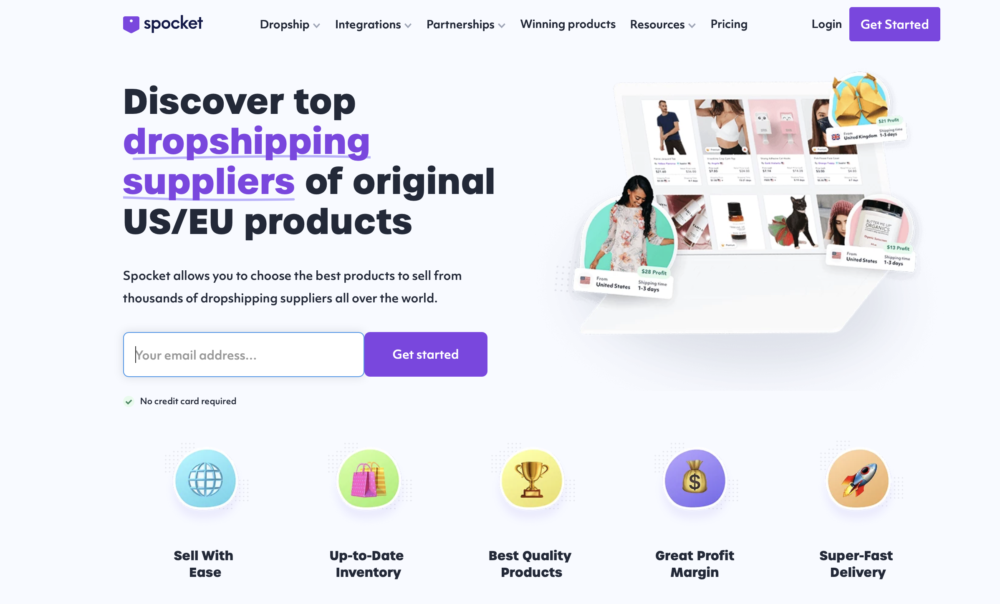
Spocket positions itself as a dropshipping platform designed to reduce those pain points by focusing on vetted suppliers, a large catalog with strong US and EU coverage, and tight integrations with major commerce platforms.
SpocketOverall verdict: Spocket is a strong option if you want a more curated supplier marketplace and better shipping expectations than the classic “long-tail overseas” model. It’s not the cheapest route, and the plan/feature landscape can be confusing depending on where you subscribe (direct, Shopify App Store, mobile app). If you value speed, product selection breadth, and convenience features like branded invoicing and streamlined fulfillment, it can be worth it. If you’re extremely price-sensitive—or you need deep automation with zero billing ambiguity—you should evaluate alternatives carefully.
Rating: 7.8/10
- Features: 8.5/10
- Ease of use: 8.0/10
- Supplier and shipping experience: 7.5/10 (varies by supplier)
- Integrations: 8.0/10
- Value for money: 7.0/10
- Transparency across channels: 6.5/10
Here’s what this review covers
- Overview and company background
- Pricing and plans (with tables and “hidden costs”)
- Setup and onboarding experience
- UI and ease of use
- Core feature breakdown (catalog → importing → fulfillment → branding)
- Advanced features and integrations (including AliScraper)
- Performance, reliability, and security
- Customer support and learning resources
- Pros and cons
- User review trends and ratings
- Alternatives and comparisons
- Who it’s best for (and who should avoid it)
- Final verdict
- FAQ (15 questions)
Overview and company background
What Spocket is (and what it is not)
Spocket is a dropshipping marketplace and automation layer that connects merchants with suppliers. You browse products, import them to your store, and then use Spocket’s workflow to process orders and track fulfillment (to the extent supported by the specific supplier/product).
Spocket is not an ecommerce platform by itself. You still need a storefront (Shopify, WooCommerce, Wix, Squarespace, BigCommerce, Ecwid, Square, or another supported channel). Spocket is the sourcing/fulfillment bridge—not the storefront.
Who Spocket is for
- Shopify and multi-platform merchants who want faster shipping options and a more curated supplier directory.
- Beginners who want a guided workflow to import products and fulfill orders without negotiating with suppliers directly.
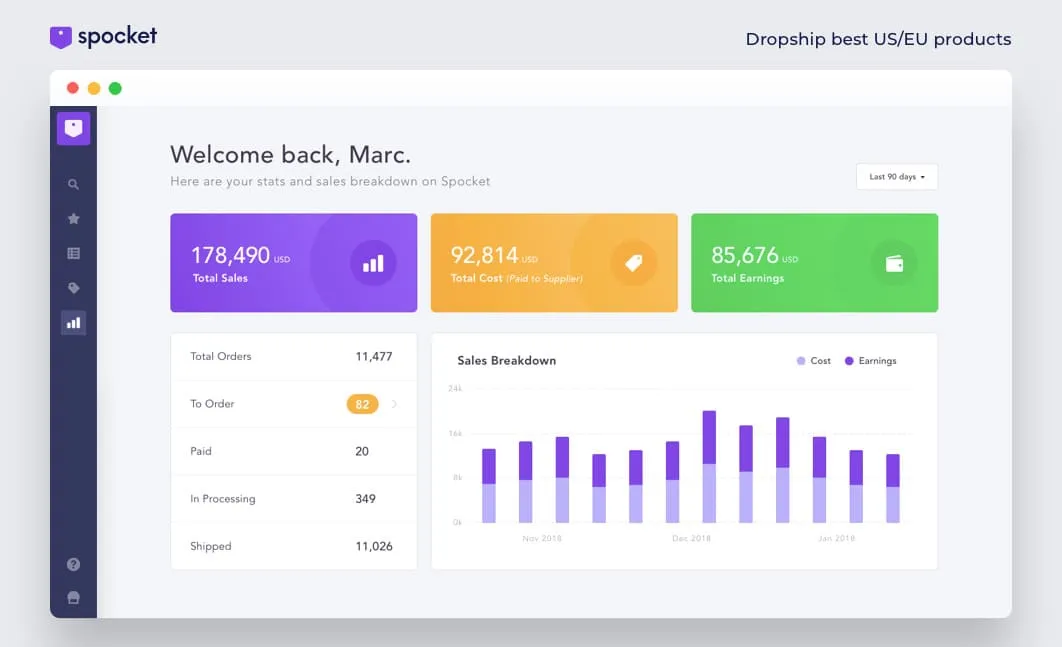
- Growing stores that need automation around inventory updates, order tracking, and catalog management.
- Merchants who care about brand presentation and want features like branded invoicing.
Company history and positioning
Spocket’s founding narrative centers on solving typical dropshipping friction (quality inconsistency and long shipping times) by emphasizing suppliers in North America and Europe, plus a workflow that feels more “systematic” than ad-hoc sourcing.
SpocketPricing and plans (with tables and “hidden costs”)
Pricing is where you should slow down and read carefully. Spocket has:
- A free plan that is typically useful for browsing/evaluating the catalog.
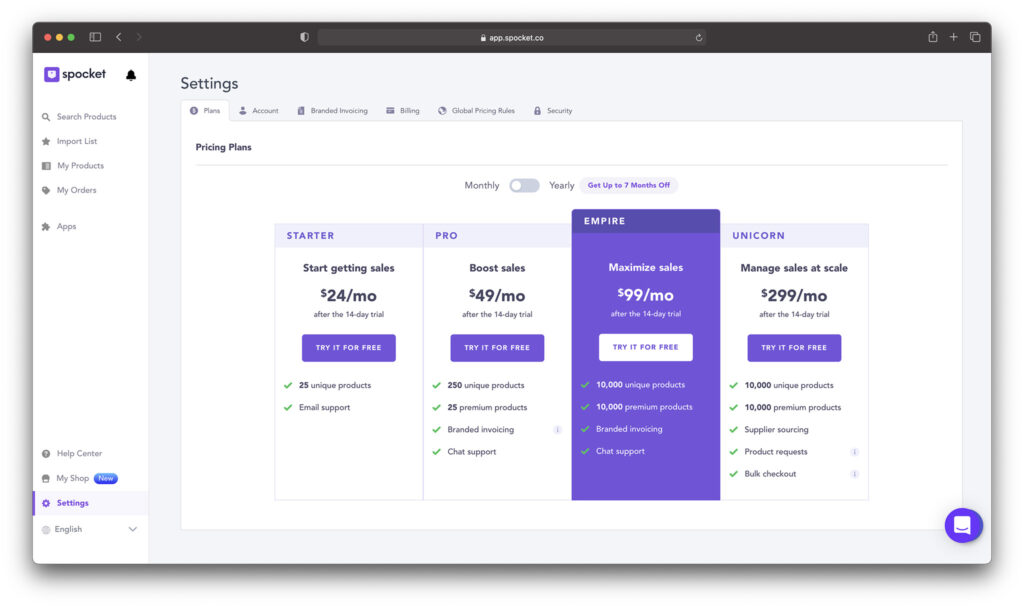
- Paid tiers (commonly marketed as Starter, Pro/Professional, Empire, Unicorn).
- Different pricing and packaging depending on whether you subscribe directly, via Shopify App Store billing, or via the iOS app.
Plans at a glance (as commonly presented on Spocket’s pricing page)
| Plan | Monthly price (direct pricing page) | Annual pricing shown (if displayed) | Unique product limit | Best for |
|---|---|---|---|---|
| Basic (Free) | $0 | N/A | Browse/catalog evaluation | Validating the marketplace before you commit |
| Starter | $39.99/mo | Not consistently displayed | 25 | Testing one niche with a tight catalog |
| Professional / Pro | $59.99/mo | $24/mo billed annually (often displayed) | 250 | Building a real store with multiple collections |
| Empire | $99.99/mo | $57/mo billed annually (often displayed) | 10,000 | Broad catalog + scaling operations |
| Unicorn | $299.99/mo | $79/mo billed annually (often displayed) | 25,000 | High-volume teams needing maximum capacity |
Important nuance: Spocket pricing can differ depending on where you subscribe (direct website vs Shopify App Store vs iOS in-app purchases). Always confirm the exact price and inclusions at checkout in the channel you plan to use.
Channel pricing differences (why “the same plan” can cost more)
| Channel | What to expect | Practical takeaway |
|---|---|---|
| Direct (Spocket site) | Commonly displays lower “headline” monthly prices plus annual discounts. | Best for price clarity—if you’re comfortable subscribing direct. |
| Shopify App Store billing | Often includes trial language and Shopify-managed billing; may mention external charges billed separately. | Convenient for Shopify-first operators, but read billing notes closely. |
| iOS in-app purchase | Can be materially higher than direct pricing (common in app-store billing due to platform fees/packaging differences). | Do not assume iOS pricing matches web pricing. |
Hidden costs you should plan for
- Cost of goods + shipping: Your supplier charges are separate from your Spocket subscription. Your real margin is subscription + COGS + shipping + refunds + support overhead.
- Customs duties/taxes: International shipments can trigger duties/taxes that are not included in product pricing. If you don’t communicate this clearly, it becomes customer friction fast.
- Multiple stores: If you run multiple stores, Spocket commonly requires a separate subscription per store.
- Platform limits: Shopify has variant-creation API limits that can block large imports (especially with multiple variants). Import in batches and pace your pushes.
- Plan-gated operations: Some efficiency features (for example, bulk processing) may be restricted to the highest tier.
Value-for-money (how to choose a tier)
- Basic: useful only to evaluate products and suppliers. You will typically need a paid plan to actively import/push products into a live store.
- Starter: best for a focused niche test (and the 25-product cap can be a helpful constraint).
- Pro/Professional: the practical tier for most serious stores because 250 products gives real testing room.
- Empire/Unicorn: justified when you’re scaling product breadth or order volume and you need operational leverage.
Setup and onboarding experience
What onboarding actually looks like
Spocket onboarding is primarily about connecting your store and then filtering the catalog down to products that match your niche, margin targets, and shipping promise. Connecting the integration is usually quick; product selection and positioning is where you’ll spend time.
Common onboarding hurdles (and how to avoid them)
- Hitting free-plan limits: Use the free plan to shortlist products and suppliers, but plan to upgrade once you’re ready to publish products and take orders.
- Importing too many products at once: Import in batches (especially if you have many variants) to reduce API throttling and mapping errors.
- Skipping supplier validation: Always order samples for your top products before you scale spend.
Best-practice rollout:
- Connect your store.
- Shortlist 20–40 products and order samples of the top 3–5.
- Build listings with brand-appropriate titles/descriptions (don’t ship generic text).
- Run small spend tests and monitor delivery/tracking quality.
- Scale only after you’ve proven supplier reliability.
UI and ease of use
Spocket’s interface is typically organized around a few core areas:
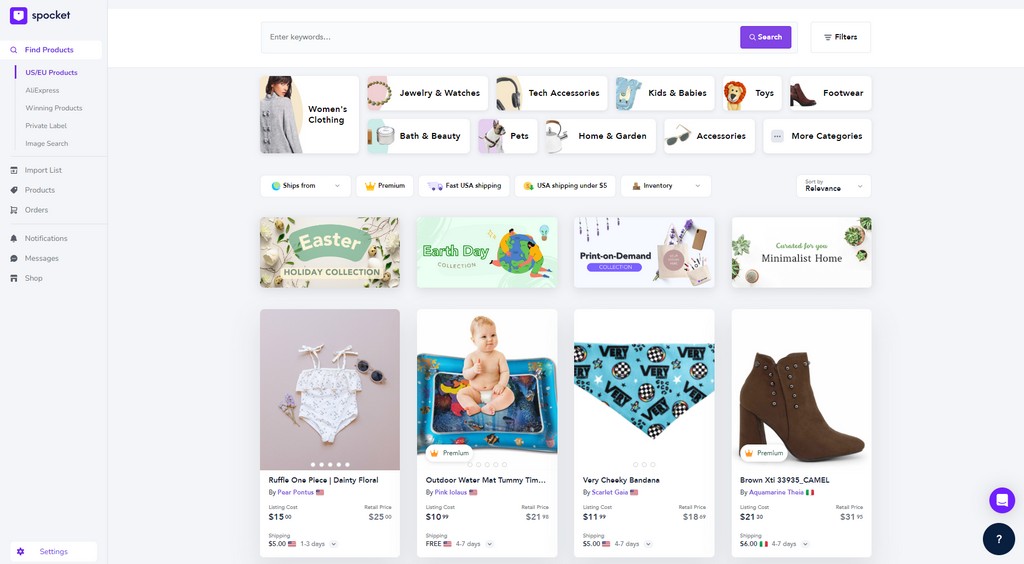
- Catalog browsing (find products and suppliers)
- Importing (push products into your store)
- Orders (process/fulfill, tracking, status monitoring)
- Settings (store connections, billing, branding settings)
Learning curve
For beginners, Spocket is typically easier than building a supplier network from scratch because the workflow is guided. The main learning curve is business-side: margin math, returns, customer expectations, and supplier variability.
Mobile experience (practical note)
Spocket offers an iOS app that is useful for monitoring, but many merchants still prefer the web dashboard for day-to-day operations (especially catalog work and order handling). If mobile matters to you, validate the current app experience before committing.
SpocketCore feature breakdown
To evaluate Spocket correctly, map features to your workflow: product research → listing creation → fulfillment → customer experience.
1) Product sourcing and catalog depth
Catalog size matters less than catalog usability: how quickly you can find products that match your niche, margin requirements, and shipping promise. Spocket’s unique product limits by tier matter because they determine how broad you can go without bumping into caps.
How to evaluate the catalog quickly
- Start with shipping reality: prioritize domestic options for your target market where possible.
- Check margin viability: aim for a realistic post-refund margin (commonly 20–40% for many niches, depending on ad costs and returns).
- Avoid pure commodities: unless you have an unfair advantage (existing traffic, strong upsells, unique positioning).
2) Supplier vetting and product quality
Spocket emphasizes vetted suppliers and stronger US/EU coverage, but performance still varies by supplier. “Vetted” does not mean identical shipping time, packaging quality, or consistency.
Non-negotiable validation step: order samples of your top 3–5 products, time delivery end-to-end, and evaluate packaging + quality + tracking accuracy before you scale spend.
3) Product importing and listing control
Importing is only step one. What matters is how much control you have over:
- Titles and descriptions (brand voice matters)
- Pricing and “compare-at” strategy
- Variants and images
- Inventory sync behavior
If you import heavily, do it in batches. Large imports with many variants can hit platform limits and create operational friction.
4) Order management and fulfillment workflow
Spocket’s operational value is highest if it reduces order handling labor. If you process meaningful daily volume, features like bulk handling (when available in your tier) can be the difference between “manageable” and “chaos.”
5) Inventory and price syncing
Inventory drift is one of the fastest ways to destroy dropshipping trust. Spocket supports inventory monitoring and sync mechanisms, but the practical limitation remains: your sync accuracy depends on supplier data quality and update cadence.
6) Shipping + tracking transparency
If your customers can self-serve tracking status, you get fewer tickets. The practical test is simple:
- Can you see the courier + tracking number reliably?
- Can you verify processing/shipping time expectations per product?
- Do customers get consistent shipment notifications?
7) Branded invoicing and brand presentation
Branded invoicing is one of Spocket’s signature features. It won’t turn dropshipping into a fully custom brand experience by itself, but it can reduce the “generic store” feel—especially if you also improve your listing copy and post-purchase comms.
Spocket8) Multi-store management
Spocket can support multiple stores under one account, but it commonly requires a separate subscription per store. Operationally this is useful; financially it can get expensive quickly for multi-brand operators.
Advanced features and integrations
1) Integrations ecosystem
Spocket highlights integrations across major ecommerce platforms (Shopify, WooCommerce, Wix, Squarespace, BigCommerce, Ecwid, Square) and also promotes marketplace-related connectivity (availability can vary by plan and geography).
2) AliScraper (AliExpress import and automation)
AliScraper (a Chrome extension powered by Spocket) expands Spocket beyond “curated US/EU” by enabling AliExpress product imports and automation patterns (inventory sync, price sync, bulk workflows). If you want a hybrid model—curated products plus AliExpress reach—this can be strategically useful.
3) Marketplace connections and plan gating
Marketplace integrations (for example, eBay) and operational accelerators (for example, bulk checkout) are often plan gated. If your model depends on these, validate the exact plan requirements before you commit.
Rule: if a feature saves you labor every single day (bulk processing, auto-sync, marketplace connections), treat plan gating as a core part of your unit economics—not a footnote.
Performance, reliability, and security
Reliability and operational maturity
Spocket’s reliability is most visible in process maturity: how well orders sync, how consistently tracking updates, and how often catalog data remains accurate. Unlike some work platforms, Spocket does not typically present a widely visible public uptime dashboard in the same way enterprise SaaS tools do, so your best validation methods are:
- Order samples and test orders
- Small volume live tests before scaling ad spend
- Reviewing recent user feedback patterns across your primary channel (Shopify App Store if you’re Shopify-first)
Security and privacy (what you should actually do)
Spocket touches sensitive workflows: customer identity, shipping addresses, order data, and billing. Treat it like any other vendor in your stack:
- Read the privacy policy and data processing terms.
- Confirm how duties/taxes are handled and reflect this in your store policies.
- Use principle-of-least-privilege where platform permissions allow it.
Customer support and learning resources
Dropshipping issues are often operational (late deliveries, supplier changes, out-of-stock surprises), not purely technical. A strong help center and responsive support can materially reduce your time-to-resolution.
- Help center documentation: integrations, store setup, order handling, and troubleshooting.
- Live support: typically marketed as chat/email support availability.
- Learning resources: academy-style content for tactics beyond software clicks.
Pros and cons
| Pros | Cons |
|---|---|
|
|
User review trends and ratings summary
No single review platform is “truth,” but patterns matter—especially for billing friction, support responsiveness, and shipping reliability.
| Platform | What to look for |
|---|---|
| Shopify App Store | Trends in merchant satisfaction, support feedback, and billing/trial expectations. |
| G2 | More structured SaaS-style feedback on value and feature completeness. |
| Capterra | Broader SMB feedback; scan for recurring operational pain points. |
| Apple App Store | A proxy for mobile experience quality; validate if mobile is core to your workflow. |
Common praise themes
- Faster shipping versus long-lead-time dropshipping models (when you choose the right suppliers).
- Convenience of importing and store integrations.
- Branding improvements via branded invoices.
Common complaint themes
- Billing/trial expectations and subscription management confusion.
- Support experience inconsistency (varies by case and urgency).
- Supplier variability (quality/shipping differences across products).
Alternatives and comparisons
Spocket is one approach to sourcing + automation. Depending on your strategy, an alternative may fit better.
| Platform | Best for | Strength | Watch-outs |
|---|---|---|---|
| Spocket | Curated suppliers + branded invoicing + multi-platform coverage | US/EU supply story, brand polish, guided workflow | Channel pricing inconsistency; plan-gated scaling features |
| DSers | AliExpress-first dropshipping | Deep AliExpress workflow and mapping at scale | Shipping expectations depend heavily on supplier/location |
| AutoDS | Automation-heavy multi-supplier model | Monitoring and automation breadth | Operational complexity can rise quickly |
| Zendrop | Dropshipping + POD hybrid | Simple model for certain niches; branding options | Coverage and economics vary by category |
| CJdropshipping | Agent-assisted sourcing + fulfillment | Sourcing support that can reduce “supplier hunting” | Service-fee economics and workflow differences |
When to choose Spocket
- You care about a curated supplier marketplace and a faster-shipping narrative.
- Branded invoicing and customer trust signals matter in your niche.
- You want storefront flexibility (not “one platform only”).
- You want optional AliExpress reach via AliScraper without fully committing to AliExpress-first tooling.
Who Spocket is best for (and who should avoid it)
Spocket is best for
- US/Canada/EU-focused merchants who want faster delivery expectations than long-lead overseas models.
- Brands that care about presentation and want branded invoicing to reduce the “generic dropshipper” feel.
- Operators who want a guided workflow rather than building supplier relationships from scratch.
- Hybrid sourcing models (curated catalog plus AliExpress reach) when you validate suppliers carefully.
Who should avoid it
- Ultra budget operators: if subscription cost is a dealbreaker, you may prefer other sourcing paths.
- Multi-store operators who want one subscription: per-store subscriptions can get expensive fast.
- Teams that require perfect billing simplicity: channel price differences can create friction if you don’t plan carefully.
- Anyone unwilling to validate suppliers: no platform eliminates supplier variability—samples are mandatory.
Final verdict and recommendations
Rating: 7.8/10
Spocket is not a magic button for dropshipping success. It’s a tool that can make the operational side of dropshipping more structured—especially if you want a curated marketplace and a faster shipping story without building supplier relationships from scratch.
Why not higher?
Because pricing and packaging can feel inconsistent across channels, and certain operationally important features can be plan gated—meaning your workflow economics can change depending on tier.
Why still strong?
Because it covers the core needs of many dropshippers: catalog access, integrations, tracking workflows, brand polish via branded invoicing, and a guided way to fulfill orders.
Recommendation by business stage
- Just exploring: use the free plan to shortlist products and suppliers, then order samples.
- Launching a focused niche store: Starter can work if you keep product count tight and validate suppliers early.
- Building a real catalog: Pro/Professional is typically the most practical tier for most merchants.
- Scaling: evaluate Empire/Unicorn based on product breadth and operational needs (bulk handling, marketplace connections, team workflow).
Call to action: If you’re evaluating Spocket, don’t start by importing 200 products. Start by ordering 3–5 samples, proving shipping/tracking reality, and then scaling your catalog only after the supplier experience matches your brand promise.
FAQ (15 questions)
1) Is Spocket free to use?
Spocket typically offers a free plan that’s mainly useful for browsing and evaluating products. For active importing/pushing products into a live store, you will generally need a paid plan.
2) How much does Spocket cost per month?
Spocket commonly markets Starter, Pro/Professional, Empire, and Unicorn tiers with monthly pricing. Exact pricing can vary by subscription channel (direct vs Shopify billing vs iOS), so confirm at checkout.
3) Does Spocket offer annual billing?
Yes—annual billing discounts are often shown on the pricing page for higher tiers. Always verify which tiers and discounts are currently offered.
4) How many products can I list with Spocket?
Product limits are typically tier-based (for example: Starter 25, Pro/Professional 250, Empire 10,000, Unicorn 25,000 unique products). Verify current limits in your plan.
5) Can I connect Spocket to Shopify?
Yes. Spocket supports Shopify integration, commonly either by connecting inside your Spocket account or installing via the Shopify App Store.
6) Does Spocket work with WooCommerce?
Yes. Spocket supports WooCommerce, but you should ensure your site meets basic technical requirements (HTTPS/SSL) and validate the integration workflow early.
7) Why can’t I push/import products to Shopify?
Common reasons include being on a free plan, hitting platform/API limits (especially variant limits), or integration misconfiguration. Importing in batches is often the most reliable approach.
8) Does Spocket support faster shipping?
Spocket’s positioning emphasizes US/EU supplier options that can reduce shipping times. Actual shipping performance depends on the specific supplier and product.
9) How do I validate supplier quality?
Order samples of your top products, measure delivery time, inspect packaging, and evaluate product quality before scaling your marketing spend.
10) Does Spocket offer branded invoicing?
Branded invoicing is one of Spocket’s better-known features and can improve customer perception compared to fully generic fulfillment paperwork.
11) Does Spocket handle customs duties and taxes?
Generally, customs duties and taxes are destination-dependent and may not be included in product pricing. You should communicate this clearly to customers where applicable.
12) Can I manage multiple stores in one Spocket account?
Spocket can support multiple stores, but many setups require a separate subscription per store. Confirm this if you operate multiple brands.
13) What is AliScraper?
AliScraper is a Chrome extension powered by Spocket that supports importing AliExpress products and running automation patterns like inventory and price syncing.
14) Is Spocket good for high-volume stores?
It can be—especially on higher tiers that expand product limits and unlock operational accelerators. Validate plan gating for bulk workflows before committing.
15) Spocket vs DSers / AutoDS / Zendrop / CJdropshipping—what should I pick?
Pick Spocket if you value curated suppliers, a US/EU shipping narrative, and branded invoicing. Pick DSers if you’re AliExpress-first. Pick AutoDS if you want broad automation and monitoring. Pick Zendrop if you want a blended dropshipping + POD story. Pick CJdropshipping if you want more agent-like sourcing/fulfillment support.


By clicking Sign In with Social Media, you agree to let PAT RESEARCH store, use and/or disclose your Social Media profile and email address in accordance with the PAT RESEARCH Privacy Policy and agree to the Terms of Use.