Oyster HR Review: Pricing, Features, Integrations, and Real World Fit
Hiring internationally sounds simple until you try to do it.
You find a great candidate in Spain. They are ready to start on Monday. Your team is excited. Then the boring, sharp edged questions show up. Who is the legal employer? What goes into the contract to meet local law? How do payroll taxes work? What benefits are required? What happens if things do not work out and you need to terminate?
If you have ever felt that stomach drop, you already understand why platforms like Oyster exist.
Overall verdict (short version): 8.6/10
Best for: startups and mid-market teams hiring internationally (employees and/or contractors) who want a single operational layer for compliant agreements, onboarding, payments, benefits, and reporting—without setting up local entities in each country.
Not ideal for: organizations that already operate primarily through owned entities everywhere and want maximum in-house control, or teams that want a full HR suite in one product (deep performance management, LMS, heavy time tracking, etc.). Also not ideal if you need a verified mobile-first manager/employee experience—treat Oyster as primarily web-based and validate mobile needs during evaluation.
Here’s what this review covers
- Introduction
- Overview and company background
- Pricing and plans (with hidden costs)
- Setup and onboarding experience
- User interface and ease of use
- Core features breakdown (EOR, contractors, payroll, benefits, compliance)
- Advanced features and integrations (top integrations table)
- Performance, reliability, and security
- Customer support and learning resources
- Pros and cons
- User reviews and ratings trends
- Alternatives and comparisons
- Who Oyster is best for (and who should avoid it)
- Final verdict and recommendations
- FAQ (15 questions)
Introduction
Oyster HR is a global employment platform built to help companies hire, pay, and support international team members without setting up local entities. It focuses on three big areas: Employer of Record (EOR) hiring for full time employees, contractor management, and multi-country payroll.
Practical framing: Oyster is not “just payroll.” It is a workflow layer for global employment—contracts, compliance posture, benefits, onboarding/offboarding, approvals, and integrations—wrapped around payments.
My rating is 8.6/10. Oyster earns that score because the core product idea is strong, coverage is broad, integrations are deeper than many buyers expect, and the company has invested in trust signals (for example, SOC 2 Type II and B Corp certification). The predictable tradeoff is that global employment is never “set it and forget it”—pricing can look simpler than the final bill, and the experience can vary by country because local rules and local partners vary.
Overview and company background
What Oyster is trying to be
Oyster is designed to sit between your company and the complexity of hiring across borders. In practice, it is trying to make global employment feel like a manageable operational system instead of a legal research project.
What Oyster covers (at a high level)
- EOR employment: hire full-time employees without setting up local entities.
- Contractor management: generate compliant contracts, manage invoices/expenses, pay contractors across borders.
- Global payroll: consolidate payroll operations across multiple countries (especially when you already have entities).
Credibility signals that matter
- Founded: January 2020 (Tony Jamous and Jack Mardack).
- Funding timeline (high level): Series B (2021), Series C (2022), Series D (2024) reported publicly.
- B Corp: certified since May 2023 (a meaningful differentiator for values-driven buyers).
- SOC 2 Type II: published SOC 2 Type II completion (January 2023) and positions ongoing security practices and reporting access via security dashboard.
Why this matters: global employment platforms touch contracts, payroll, identity data, and benefits. Trust posture is not a “nice-to-have”—it determines whether procurement and security will approve the vendor.
Coverage positioning (what Oyster claims publicly)
- Contractors: 180+ countries
- EOR: 120+ countries
- Payments: 120+ currencies
Pricing and plans (with hidden costs)
Pricing is where most global employment evaluations get messy, because the platform fee is only one part of total cost. Oyster publishes clear starting points—but you still need to model statutory costs, benefits, and country-specific requirements.
Oyster pricing at a glance (public list pricing)
| Product line | Public starting price | Best for | What to validate |
|---|---|---|---|
| Contractor | $29 per contractor / month (after 30-day free period) | Paying global contractors with contract + payment workflow | Any add-ons (misclassification protection), payout fees, country-specific constraints |
| Employer of Record (EOR) | Starts at $699 per employee / month | Hiring full-time employees without local entities | Total employment cost (taxes, statutory benefits, optional benefits), offboarding/termination specifics |
| Payroll | $29 per employee / month | Consolidating multi-country payroll (where entities already exist) | Country coverage list, implementation complexity, integration fit with finance/HRIS |
Budget reality check: for EOR, the platform fee is not the same as total employment cost. Your all-in cost includes salary + employer taxes + statutory contributions + benefits (minimum and/or competitive), plus country-specific operational items.
Hidden costs and add-ons you should expect
Even in the best global employment platforms, the “hidden costs” are usually not scams—just real world country requirements and optional programs that become necessary when you scale.
- Statutory costs: employer-side payroll taxes, social contributions, mandatory insurance, mandatory benefits.
- Competitive benefits upgrades: to hire successfully in certain markets.
- Contractor misclassification protection: Oyster positions “Oyster Shell Protection” as a paid add-on with aggregate coverage up to $500,000.
- Visa sponsorship / mobility: Oyster promotes visa sponsorship in 60+ countries—usually not a “free” service in this category.
- Equity support: Oyster highlights equity support in 40+ countries; equity administration often adds complexity and service scope.
Value for money: when Oyster tends to make sense
- Contractor plan: strong value if you want compliant contract workflows + multi-currency payments (not just payouts).
- EOR: strongest value when it replaces entity setup + local legal + local payroll + benefits broker sprawl.
- Payroll: most compelling when you already have entities but want to consolidate payroll operations and reporting across multiple countries.
Setup and onboarding experience
Global employment tools fail when setup is painful. Oyster positions itself as fast to start, including claims like onboarding new EOR talent in as fast as 48 hours in some cases.
A practical onboarding path (what teams actually do)
- Decide worker type per hire: contractor vs employee (EOR).
- Select country + confirm service model: country rules drive everything (contracts, benefits, termination, payroll schedules).
- Set compensation + currency + pay schedule: document it early to reduce later changes.
- Run onboarding checklist: identity details, tax forms where applicable, bank details, contract signing.
- Connect systems: HRIS/ATS/finance/expenses so you avoid double entry.
Where teams get slowed down (even with good tooling)
- Classification decisions: “contractor vs employee” is often the hardest early call.
- Benefits choices: minimum compliance vs competitive package.
- Payroll cutoffs: local pay cycles and submission deadlines are real constraints.
- Offboarding reality: termination rules vary dramatically by country; align expectations early.
User interface and ease of use
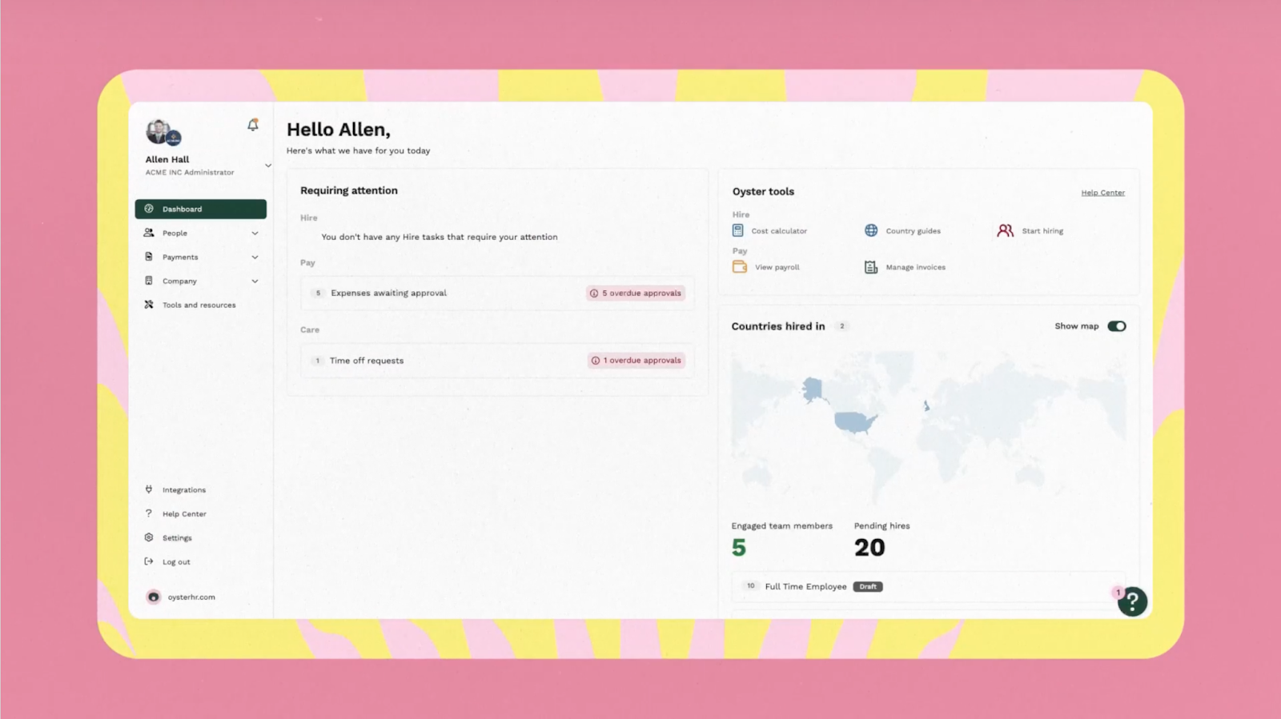
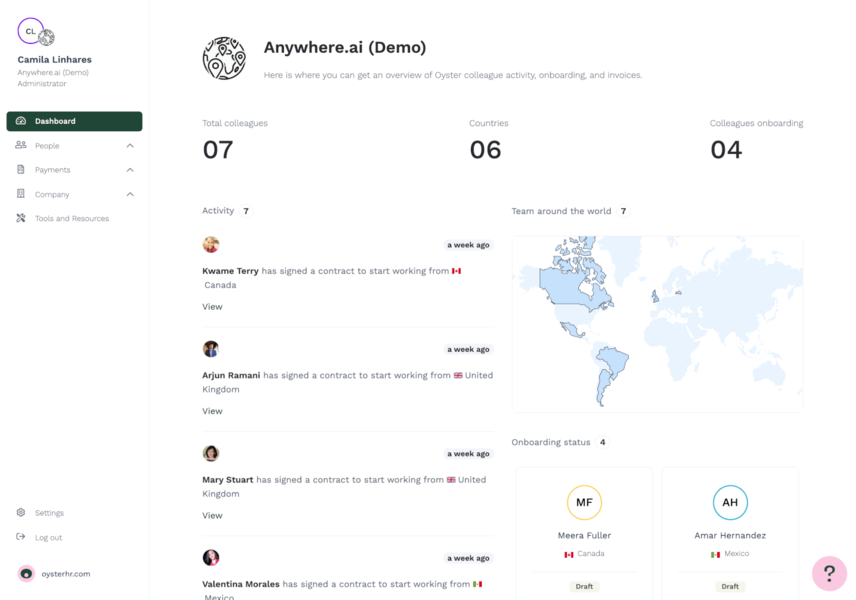
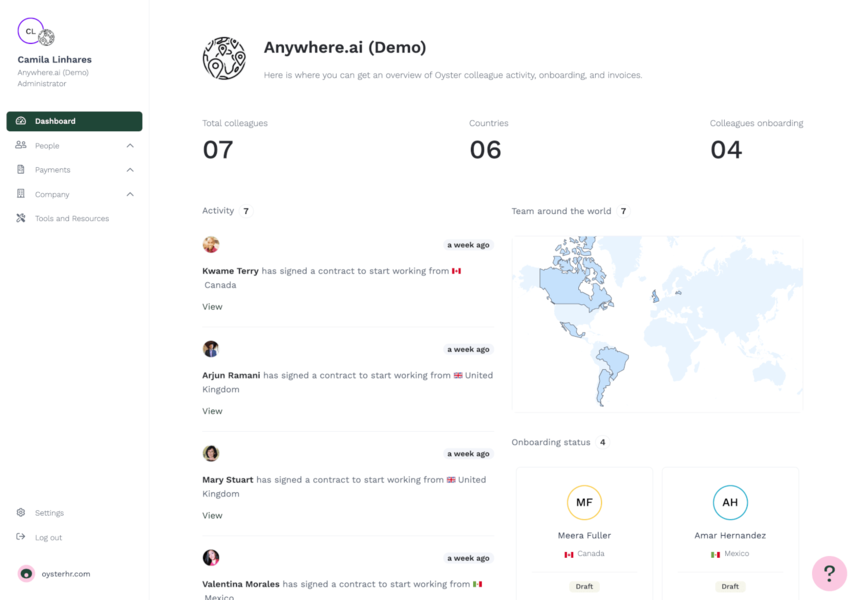
Oyster’s UI is best understood as workflow-first. The goal is not to be a fully customizable HRIS. The goal is to make global employment operationally manageable.
What the interface is optimized for
- Onboarding and offboarding workflows
- Contract generation and document management
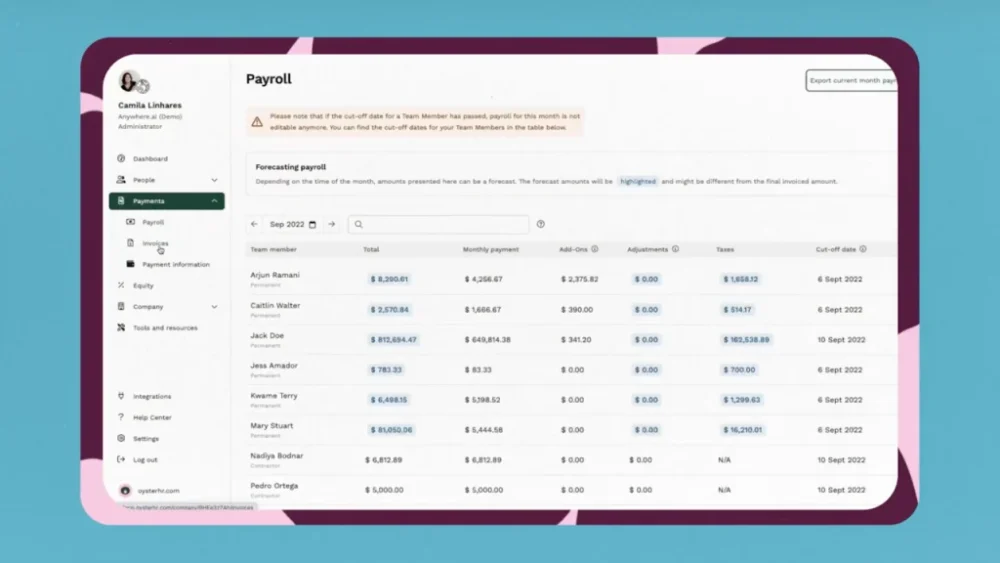
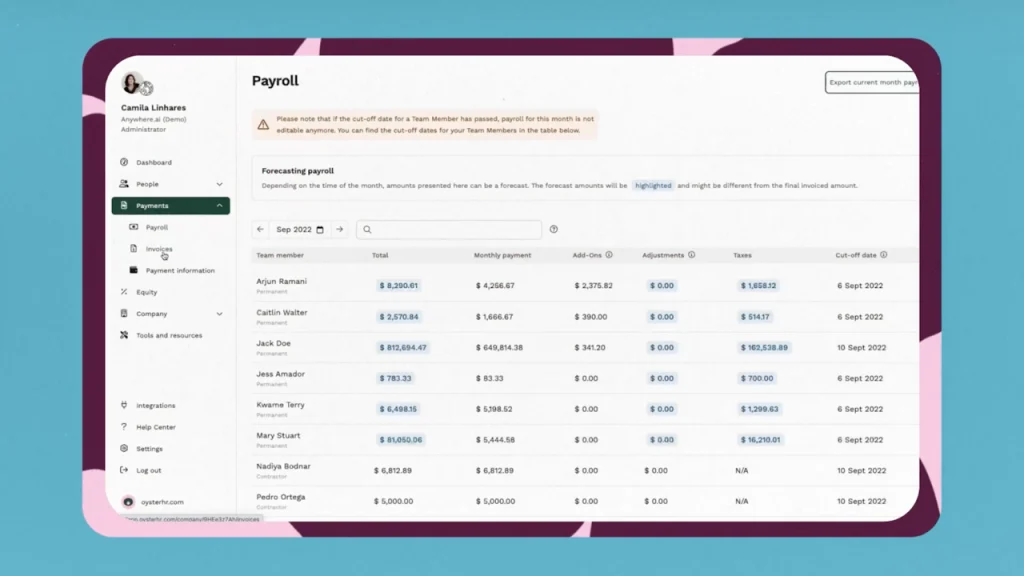
- Payments operations (contractors and payroll)
- Time off and expenses (where enabled)
- Benefits and equity support workflows
- Reporting and exports for finance and HR stakeholders
Learning curve: two curves, not one
Tool learning curve (usually manageable): how fast your admins can create contracts, approve invoices, run payroll tasks, and pull reports.
Domain learning curve (the real one): global employment rules, local norms, statutory obligations, termination constraints, and benefit expectations. Oyster can guide you, but the complexity does not disappear.
Mobile experience
Oyster’s public posture is web-first. If mobile manager approvals or employee self-service is a hard requirement for your org, treat mobile as a dedicated evaluation track in your demo (do not assume parity with mobile-first HR platforms).
Core features breakdown (EOR, contractors, payroll, benefits, compliance)
Oyster is broad. To evaluate it well, tie each feature category to your real hiring plan (countries + worker types) and your real operating requirements (approvals, reporting, integrations, compliance posture).
1) Employer of Record (EOR)
EOR is the flagship use case: hire full-time employees in a country where you do not have an entity. Oyster positions EOR around compliant employment agreements, payroll and taxes, benefits, and ongoing people operations.
- When it shines: you need to hire in 1–10 countries quickly without building a local infrastructure stack.
- What to validate early: employment agreement flow, benefits options, payroll cadence, and offboarding rules in your top 2–3 countries.
2) Contractor management
Contractors are where companies often move fast and regret it later. Oyster’s contractor layer is designed to formalize contract + payment operations, and it positions compliant agreements and multi-currency payments as the center of the workflow.
- Contracts: country-specific templates and signing workflows.
- Payments: multi-currency payouts and consolidated administration.
- Risk posture: misclassification protection exists as an add-on (not automatic).
3) Global payroll
Global payroll is for companies that already have entities but want standardized payroll operations and consolidated reporting. Oyster positions payroll as automated and supported by local experts, with coverage described across 30+ countries.
Key validation step: confirm your exact country list, payroll calendars, and how payroll data reconciles into your finance stack (ERP/accounting) and HRIS.
4) Benefits and local packages
Benefits are not optional in global hiring. They are compliance and competitiveness. Oyster positions “ready-made benefit packages tailored to each market” and workflows for managing benefits and (in some cases) equity.
5) Time off and expenses
These features sound small until you manage them across five countries. The value is consistency: approvals, policies, and records living in the same system as contracts and payroll reduce mismatches and audit pain.
6) Compliance and contracts management
Oyster anchors its narrative on compliance: legal-reviewed agreements, built-in compliance positioning, and local expertise. The practical question is whether the platform helps you operationalize compliance (templates, approvals, documented records) rather than just promising it.
7) Reporting and insight tools
Reporting matters for finance and leadership: headcount by country, cost by worker type, payroll summaries, contractor spend, and policy compliance. Oyster also markets salary insights across 130+ countries—useful if compensation benchmarking is a bottleneck for offers.
Advanced features and integrations
Advanced feature: Visa sponsorship / talent mobility
Oyster promotes visa sponsorship support in 60+ countries. If relocations are part of your hiring plan, this is worth evaluating because mobility projects become time-consuming quickly without a structured vendor workflow.
Advanced feature: Equity support
Oyster has highlighted equity support in 40+ countries. Equity across borders is complex; even partial support can remove weeks of legal back-and-forth when scaling internationally.
Integration ecosystem: why it matters
Integrations determine whether Oyster becomes a real operational layer or “another tab.” Oyster’s integration list spans HRIS, ATS, finance, expenses, identity, equity, collaboration, automation, and API access.
Top integrations table (high-impact picks)
| Category | Examples Oyster highlights | Why teams care |
|---|---|---|
| HRIS / Core HR | Workday, BambooHR (HRIS), HiBob, Personio, ADP Workforce Now, Humaans | Reduce double entry; keep employee records consistent across systems |
| ATS / Recruiting | Greenhouse, Ashby, BambooHR ATS | Connect hiring pipeline to onboarding workflows |
| Identity | Okta | Centralize access control and security posture |
| Finance / Accounting / ERP | NetSuite, QuickBooks Online, Xero | Reconcile payroll and contractor spend; improve close accuracy |
| Expenses | Concur Expense, Expensify | Standardize expense capture and approvals across countries |
| Equity administration | Carta | Coordinate equity workflows with global employment reality |
| Collaboration | Slack | Status updates and internal visibility for HR/finance stakeholders |
| Automation | Zapier | Connect long-tail tools without custom development |
| Developer | Oyster API | Custom integrations and internal dashboards |
Zapier and long-tail workflows
If your HR tech stack includes niche tools, Zapier coverage can matter more than one additional “native” integration. The practical win is automating handoffs: onboarding notifications, cost center tagging, data pushes into spreadsheets or PM tools, and status updates to managers.
Performance, reliability, and security
Operational reliability
For global employment platforms, reliability is mostly about two things: payments arriving correctly and on time, and operational workflows being consistent enough that HR and finance can close books confidently.
- Payments: Oyster publicly highlights multi-currency payments and a high accuracy narrative for contractor payments.
- Scalability: coverage positioning supports “add countries over time” growth patterns.
Security posture and trust signals
Oyster positions a SOC 2 Type II posture and publishes security-oriented statements like report availability via a security dashboard and regular penetration testing. It also supports two-factor authentication.
Procurement tip: if you are security-review heavy, ask for (1) SOC 2 Type II report access path, (2) pen test summary posture, (3) role-based access and auditability details, and (4) data processing terms for cross-border transfers.
Customer support and learning resources
Support matters more in global employment than in most SaaS categories. When payroll is wrong, it is not just a ticket. It is someone’s rent.
What to look for in your evaluation
- Country-specific expertise: can you reach local specialists when edge cases arise?
- Response time consistency: especially around payroll cutoffs and urgent employment events.
- Clear escalation paths: for payroll or compliance-sensitive situations.
- Educational resources: guides, calculators, and policy templates reduce mistakes early.
Oyster’s public site emphasizes educational resources (global hiring guides, calculators, and learning content). If you are new to global hiring, this layer is often nearly as valuable as the platform itself.
Oyster HRPros and cons
Pros
- Broad coverage: contractors (180+ countries) and EOR (120+ countries), payments in 120+ currencies.
- Clear entry pricing: contractor pricing is easy to budget and includes an initial free period.
- Operational scope: beyond paying people—contracts, onboarding, time off, expenses, benefits, equity support, reporting.
- Integration depth: HRIS, ATS, finance, expenses, identity, equity, collaboration, automation, API.
- Trust signals: B Corp certification and SOC 2 Type II posture positioned publicly.
- Optional risk posture: misclassification protection as an explicit add-on category.
Cons
- EOR cost is a starting platform fee: total cost includes salary, employer taxes, statutory benefits, optional benefits, and country-specific details.
- Country variability: experience differs by country because labor rules and vendor/service models vary.
- Add-ons can add up: misclassification protection, mobility/visa support, equity workflows can change economics.
- Not a full HR suite: many orgs will still run an HRIS alongside Oyster.
- Mobile-first uncertainty: treat as web-first and validate mobile workflows in demo/trial.
User reviews and ratings trends
For global employment platforms, reviews are most useful when you look for patterns related to: payroll accuracy, support quality, billing clarity, and country-specific edge cases.
Ratings snapshot (directional)
- ADP Marketplace: Oyster HR is shown with a 4.3 rating and 1,304 reviews (listing snapshot).
- Trustpilot: Oyster has a dedicated presence; use it to read narrative feedback patterns (avoid over-weighting any single platform).
Common praise themes (what to expect)
- Hiring internationally without setting up entities
- Relief from contract drafting and compliance research
- One place to manage onboarding, contracts, payments, and ongoing changes
- Integrations that reduce duplicate admin work
Common complaint themes (what to watch)
- Billing surprises tied to statutory costs, benefits, or country-specific fees
- Response-time variance when issues require local expertise
- Offboarding complexity in strict labor markets
- Confusion around contractor vs employee classification decisions
Alternatives and comparisons
Oyster competes in a crowded category. Most buyers compare it against platforms like Deel, Remote, Rippling, Papaya Global, Globalization Partners (G-P), Velocity Global, and Multiplier.
How teams typically decide (practical comparison)
| Platform | Best for | Watch-outs | When Oyster tends to win |
|---|---|---|---|
| Oyster | EOR + contractors + payroll with strong integration breadth | Total EOR cost; add-ons; country variability | When you want broad coverage + deep integrations + values/trust story |
| Deel | Broad global workforce platform with many modules | Module sprawl and operational complexity | Oyster can feel calmer if you prefer a more guided operational layer |
| Remote | Buyers who prioritize entity model clarity and consistency | Coverage and service model differences by country | Oyster can win on integration breadth and B Corp trust positioning |
| Rippling | Teams wanting HR + IT + global employment under one umbrella | Can be heavy if you only need EOR/contractors | Oyster can be simpler if you already have HR/IT stack in place |
| Papaya Global | Payroll-heavy global teams | EOR and contractor workflows vary by vendor approach | Oyster can be stronger if you want contractor + EOR + integrations in one operating layer |
Quick heuristic:
If your biggest pain is “I need one person hired abroad next month,” compare Oyster, Deel, Remote, and G-P.
If your biggest pain is “we already operate globally and payroll is messy,” compare payroll-first platforms alongside Oyster Payroll.
If your biggest pain is “we want HR + IT + global employment in one suite,” evaluate Rippling-style bundles.
Who Oyster is best for (and who should avoid it)
Oyster is a strong fit if you are:
- Hiring internationally without local entities and you want to move fast without breaking compliance.
- Managing mixed worker types (employees + contractors) across multiple countries.
- Ops-minded HR/People and Finance who want contracts + onboarding + time off + expenses + benefits + reporting in one operational place.
- Integration-heavy organizations that need Oyster to plug into HRIS/ATS/finance/expense stacks.
- Trust-sensitive buyers who value SOC 2 Type II posture and B Corp certification as part of vendor selection.
Be cautious or avoid Oyster if you:
- Need a full HR suite in one tool (deep performance management, LMS, heavy time tracking).
- Want maximum control via owned entities everywhere and are prepared to build internal expertise.
- Require a verified mobile-first experience for key workflows (validate mobile requirements carefully).
Final verdict and recommendations
Oyster is a serious platform in a serious category. It is not trying to be a basic contractor payout tool. It is trying to be the operating layer for global employment: EOR hiring, contractor management, payroll, benefits, equity support, compliance workflows, and integrations that keep your HR stack coherent.
My score breakdown
| Category | Score | Why |
|---|---|---|
| Features | 9.0/10 | Strong scope across EOR, contractors, payroll, benefits, and operational workflows |
| Ease of use | 8.5/10 | Workflow-first UI helps, but domain complexity still creates learning curve |
| Integrations | 9.0/10 | Strong breadth across HRIS/ATS/finance/expenses/identity/equity + Zapier + API |
| Security and trust | 9.0/10 | SOC 2 Type II posture, B Corp certification, and explicit trust narrative |
| Value for money | 7.5/10 | Strong value when replacing entity setup; less compelling for narrow one-off needs |
Overall: 8.6/10
Recommendation: how to evaluate Oyster correctly
If you are hiring internationally this year and you want to move fast without breaking compliance, Oyster should be on your shortlist. In your demo and evaluation, validate these three items before committing:
- Your exact countries + service model in each country (EOR mechanics and partner structure can vary).
- Total cost structure including statutory benefits, employer taxes, optional benefits, and any add-ons you expect to need.
- Stack fit with HRIS/ATS/finance/expenses—confirm what is native vs Zapier vs API-driven.
FAQ (15 questions)
1) What does Oyster HR do in one sentence?
Oyster helps companies hire, pay, and manage global employees and contractors with structured compliance workflows, including Employer of Record services and multi-currency payments.
2) How many countries does Oyster support?
Oyster positions contractor coverage across 180+ countries and EOR coverage across 120+ countries.
3) How fast can Oyster onboard an employee?
Oyster markets onboarding in as fast as 48 hours in some EOR cases. Actual timing depends on country requirements and payroll cutoffs.
4) How much does Oyster cost for contractors?
Oyster lists $29 per contractor per month after a 30-day free period.
5) How much does Oyster cost for Employer of Record?
Oyster lists EOR pricing as starting at $699 per employee per month (platform fee; total cost includes statutory costs and benefits).
6) Does Oyster support multi-currency payments?
Yes. Oyster positions payments in 120+ currencies.
7) What is Oyster Shell Protection?
Oyster positions Oyster Shell Protection as an add-on that includes contractor misclassification risk assessment and aggregate protection up to $500,000.
8) Does Oyster support visa sponsorship?
Oyster promotes visa sponsorship support in 60+ countries.
9) Does Oyster support equity compensation?
Oyster has highlighted equity support in 40+ countries. Validate your specific countries and equity model during evaluation.
10) What integrations does Oyster offer?
Oyster highlights integrations across HRIS (e.g., Workday, BambooHR HRIS, HiBob, Personio), ATS (e.g., Greenhouse, Ashby), identity (e.g., Okta), finance (e.g., NetSuite, QuickBooks Online, Xero), expenses (e.g., Concur, Expensify), equity (e.g., Carta), collaboration (e.g., Slack), automation (Zapier), and an API.
11) Are integrations included or paid extra?
Oyster’s integration directory messaging indicates integrations are available to customers; confirm any plan gating and implementation scope during procurement.
12) Does Oyster have SOC 2 Type II?
Oyster has publicly stated it completed a SOC 2 Type II audit and positions report access through a security dashboard.
13) Is Oyster a B Corp?
Oyster HR, Inc. is listed as a Certified B Corporation, certified since May 2023.
14) How is Oyster rated by users?
A directional example: ADP Marketplace shows Oyster HR with a 4.3 rating and 1,304 reviews (listing snapshot). Use multiple sources and prioritize narrative patterns over a single score.
15) Is Oyster better for employees or contractors?
Oyster is built for both, but it tends to deliver the best value when you have a mix of worker types and want one operational system to manage contracts, compliance workflows, payments, and reporting across multiple countries.


By clicking Sign In with Social Media, you agree to let PAT RESEARCH store, use and/or disclose your Social Media profile and email address in accordance with the PAT RESEARCH Privacy Policy and agree to the Terms of Use.